
Chicago Construction Site Toilet Requirements
A Chicago job site answers to two toilet rules at once: the OSHA construction sanitation standard and the Chicago Plumbing Code. Here is what each requires, how to count your crew and what winter changes.
Published 16 October 2026 by Flushbridge Porta Potty Prime, 2003 W Fulton St #593, Chicago, IL 60612.
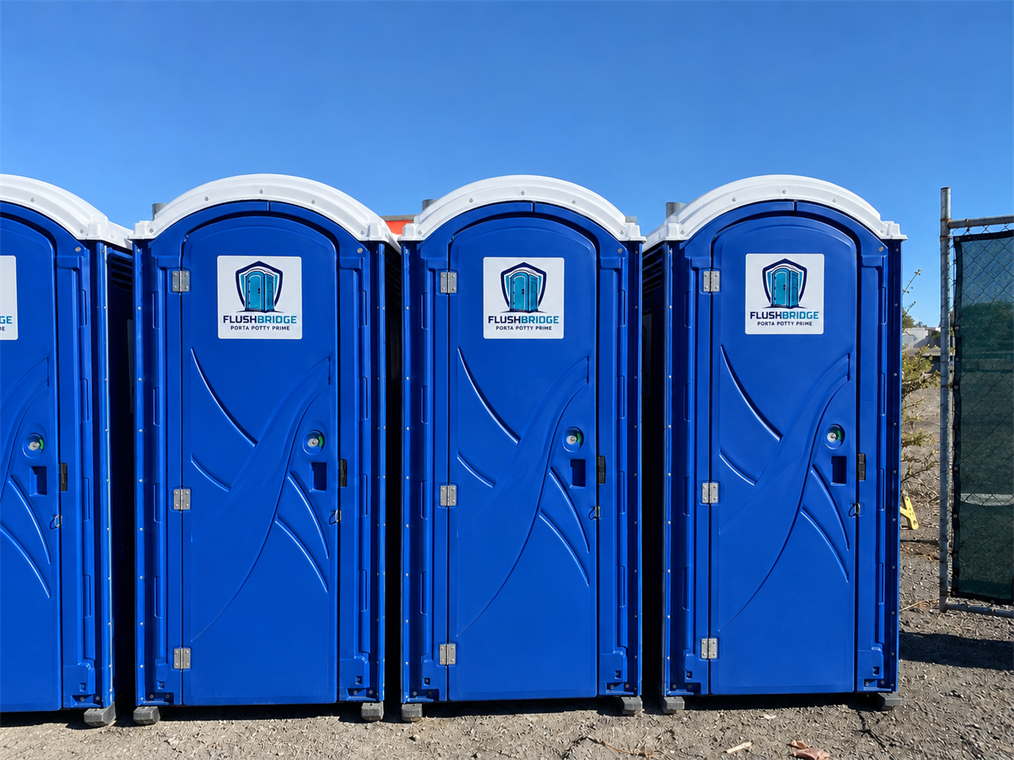
Most contractors in Chicago know there is an OSHA ratio for job site toilets. Fewer know that the Chicago Plumbing Code sets its own ratio, that it is stricter than OSHA's at some crew sizes, and that it makes it unlawful to begin work without proper and sufficient toilet facilities in place. On a job site in the city you are working to both rules at once.
Below: what the federal standard says, the Chicago section that catches people out, servicing frequency, placement, and what changes once the temperature drops.
What OSHA 1926.51 requires
The construction sanitation standard is 29 CFR 1926.51. Paragraph (c), "Toilets at construction jobsites", sets the counts in Table D-1:
- 20 or fewer employees: one facility.
- 20 or more employees: one toilet seat and one urinal per 40 workers.
- 200 or more employees: one toilet seat and one urinal per 50 workers.
The first two rows overlap at exactly 20. That is how the rule is written. The working interpretation almost everyone applies is that a crew of 20 or fewer needs one facility, and above 20 you provide one toilet seat and one urinal per 40 workers, moving to per 50 at 200 and above.
Three further parts of paragraph (c) matter on real sites:
- (c)(2) requires that under temporary field conditions, provisions be made to assure not less than one toilet facility is available.
- (c)(3) covers sites with no sanitary sewer. Unless local codes prohibit them, those sites must be provided with privies (where their use will not contaminate ground or surface water), chemical toilets, recirculating toilets or combustion toilets. A standard portable toilet is the chemical toilet option, and on most Chicago job sites it is the only practical one of the four.
- (c)(4) exempts mobile crews with transportation readily available to nearby toilet facilities. This is narrower than it sounds: a crew parked on one address all week is not a mobile crew, and a coffee shop two blocks away that may or may not let them in is not readily available.
Washing facilities and drinking water get missed
Paragraph (f) deals with washing facilities, and it is the part most often overlooked at pre-start. Paragraph (f)(3) requires that lavatories be made available at all places of employment, with the same mobile crew and unattended location exception as the toilet rule. Each lavatory must have hot and cold running water, or tepid running water. Hand soap or a similar cleansing agent must be provided, and individual hand towels of cloth or paper, sections of clean continuous toweling, or air blowers must be conveniently located near the lavatory. Paragraph (f)(2) requires washing facilities be maintained in a sanitary condition.
Paragraph (f)(1) is separate and stricter in scope: the employer must provide adequate washing facilities for employees engaged in the application of paints, coatings, herbicides or insecticides, or other operations where contaminants may be harmful. Those facilities must be in near proximity to the worksite and equipped so employees can remove the substances.
In practice a portable handwashing station with fresh and wastewater tanks, soap and paper towels is how this gets provided. The sanitizer dispenser inside a porta potty is not a lavatory.
Paragraph (a) covers potable water: an adequate supply in all places of employment, portable containers that can be tightly closed and have a tap, containers labelled and used for nothing else, no common drinking cup, and where single use cups are supplied, a clean holder for unused cups and a receptacle for used ones.
The Chicago rule most contractors miss
Chicago has its own requirement in the Plumbing Code, Chapter 18-29 of the Municipal Code. Section 18-29-311.1, headed "Workmen's temporary closets", makes it unlawful for the owner of a building, or any person employing or in charge of any persons, to begin work without proper and sufficient toilet facilities, and requires at least one water closet, chemical closet, privy or incinerator for every 30 employees or fraction thereof.
Two more details in the same section are worth writing on your site plan:
- Toilet facilities in multiple story buildings must be located so that no floor is more than four stories from a floor with toilet facilities. On a tall build that means units going up with the structure, not one bank at grade for the whole job.
- Grade level toilets must be located not closer than 5 feet from a side lot line. On a tight infill lot in Pilsen, Logan Square or the West Loop, that single clearance often decides where the unit can stand.
Compare the ratios and the effect is clear. A 60 person crew needs two seats and two urinals under OSHA and two closets under Chicago. A 95 person crew is where Chicago bites: four closets at one per 30 or fraction, against three seats under OSHA's per 40 figure. Where both rules apply you follow the stricter one, so count both and order to the higher figure.
There is also a distance trigger worth knowing. The plumbing code provision for temporary facilities generally applies where sewer and water connections are not readily available and adequate toilet facilities are not available within 500 feet. If your crew cannot reach a usable permanent restroom inside that distance, you need the temporary units and the portable handwashing to go with them.
The Illinois layer
Two points on state law. First, enforcement: Illinois does not run a state OSHA plan covering private sector employers, so a private construction site in Chicago is inspected under federal OSHA. The state plan covers state and local government employees.
Second, Illinois has its own statute on the subject, the Construction Site Temporary Restroom Facility Act at 410 ILCS 37, which places a duty on the owner or the owner's representative of a temporary building or a building under construction to see that employees on site have access to restroom facilities, and ties facility counts to the OSHA construction sanitation standards. The Act was amended in 2026 by Public Act 104-0850, which renamed it and added requirements including a separate designated toilet facility in defined circumstances where women or people who menstruate are working on the site.
Because that amendment is recent, do not plan from a summary, including this one. Read the current statutory text or have your counsel confirm what applies to your site and from what date.
Counting your crew honestly
The ratios apply to people on site, not to your payroll. Three things trip up the count:
- Subcontractors. On a day when the framers, the electricians and the mechanical crew are all on site, every one of those people is using your units. Count the peak day, not the average.
- Crew growth. Headcount is not flat. It climbs through rough-in and peaks during finishes, so a count that was right in month one is often short by month four.
- Visitors and inspectors. Not a large number, but on a site with one unit it is the difference between available and occupied.
Recount when the trades stack. Adding a unit mid-job is a phone call; a citation or a crew walking off site to find a restroom costs more.
How often units should be serviced
OSHA does not set a service interval. It sets how many facilities you provide and, for washing facilities, that they be kept sanitary. Frequency is a practical question with a compliance consequence if you get it wrong.
The common baseline across the industry is one service visit per week per unit at roughly ten workers per unit. Move above that density and weekly stops being enough. The situations that reliably need twice weekly or more are high crew counts per unit, hot weather, units that are locked overnight and unventilated, and sites where the unit is the only facility for a long shift.
A service visit means pumping the tank, recharging it with fresh deodoriser solution, restocking paper and wiping down the interior. What it cannot fix is a tank full of debris. Drywall offcuts, cups, gloves and bottles will stop a vacuum hose, and the unit then stays out of service until it is swapped. One toolbox talk at the start of the job saves several of those.
Placement on a Chicago job site
- Within reach of the service truck. The hose has a finite length and the truck needs somewhere legal to stop. On an alley-access lot, confirm the truck can get in and that nothing will be parked across it on service day.
- Off the mud. Spring thaw and summer storms turn an unpaved Chicago lot into something a unit sinks into and tips on. Plywood or a gravel pad solves it.
- Five feet off the side lot line for grade level units, per the plumbing code section above.
- Secured against wind. Units blow over, and they blow over more in the gaps between tall buildings downtown and on open sites near the lake. Strap or stake them.
- Clear of the crane swing and the fire lane. Obvious until the only remaining space happens to be both.
- Moving up with the build. See the four story rule, and plan each floor's position before the deck is poured.
- Away from the neighbours' windows and the public sidewalk. Placement complaints are easier to avoid than to answer.
Winter on a Chicago job site
Chicago winters do things to portable toilets that no ratio table mentions.
- Ask for a winter charge in the tank. The holding tank solution needs to be made up so it does not freeze solid. A frozen tank cannot be pumped, which means the unit cannot be serviced until it thaws.
- Water fed handwashing and hard freezes do not mix. Below freezing a standard fresh water sink can freeze and be damaged. Ask your supplier about winterised options, and remember that a sanitizer dispenser does not satisfy the lavatory requirement in 1926.51(f)(3).
- Ice at the door and on the step. The step is the injury risk. Grit the approach on the morning walk, and keep the latch free of ice so the door is not forced.
- Snow clearance. The edge of a lot is where snow gets pushed. Site the unit out of the dump zone or you will dig it out before every service visit. The same goes for the truck's route in.
- Winter parking rules. Chicago's overnight parking restrictions and snow route rules affect where a service vehicle can legally stop in winter. Factor that into the service window if your unit is served off the street.
- Short daylight. In December a Chicago site is dark before the shift ends, and a unit with no light near it goes unused.
A short pre-start checklist
- Work out the peak headcount including all subs on site the same day.
- Run the OSHA Table D-1 count and the Chicago one-per-30 count, and order to the higher figure.
- Add handwashing provision that meets 1926.51(f)(3), and more if anyone is applying paints, coatings, herbicides or insecticides.
- Confirm potable water arrangements under 1926.51(a).
- Fix unit positions against the 5 foot lot line clearance, the four story rule, and service truck access.
- Set a service frequency from crew density, not from habit, and review it when the trades stack.
- In winter, confirm the tank charge, the handwashing arrangement and the snow plan before the first freeze.
Flushbridge Porta Potty Prime rents standard porta potties, ADA accessible units and handwashing stations to job sites across Chicago from 2003 W Fulton St #593. Call (872) 351-8063 with your site address, crew size, start and finish dates and the servicing you need, and we can confirm units and current pricing on the call. See our construction porta potty rental page or contact details.
This page summarises published regulations for planning purposes and is not legal advice. OSHA standards, the Chicago Municipal Code and Illinois statutes are amended from time to time. Check the current text of 29 CFR 1926.51, Chapter 18-29 of the Chicago Municipal Code and 410 ILCS 37, or take advice, before relying on any figure here for a specific site.
Related rental pages
Construction rentals
Job site porta potty rentals with scheduled servicing for Chicago contractors.
Standard units
The everyday job site unit, delivered to the site and collected at the end of the rental.
Handwashing stations
Portable sinks with fresh and wastewater tanks, soap and towels for washing facility provision.
Call for a Job Site Porta Potty Quote in Chicago
Call Flushbridge Porta Potty Prime with your site address, peak crew size, start and finish dates and the servicing frequency you need. We can confirm unit counts, handwashing provision and current pricing on the call.
(872) 351-8063